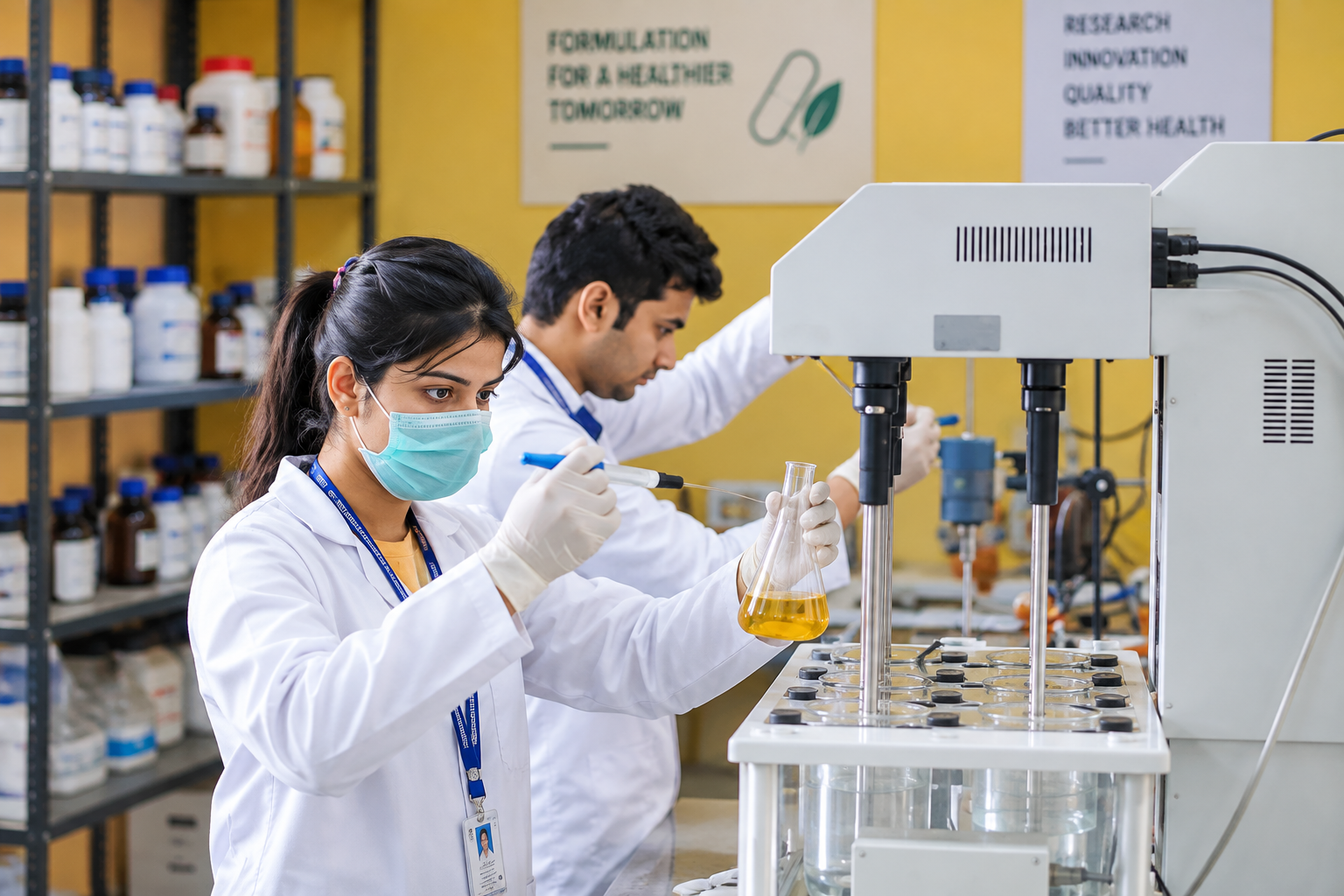
Direct Second Year Bachelor of Pharmacy is a lateral-entry degree program designed for eligible Diploma in Pharmacy holders who wish to advance their education in pharmaceutical sciences and healthcare. The program builds advanced knowledge of medicines, formulation, drug action, quality assurance and pharmacy practice.
Direct Second Year B.Pharmacy provides an educational pathway for eligible Diploma in Pharmacy graduates to pursue a bachelor's degree in pharmacy through lateral entry.
The program expands students' understanding of pharmaceutical technology, medicinal chemistry, pharmacology, pharmaceutical analysis, quality assurance and patient care.
Classroom instruction, laboratory activities and practical learning help students develop scientific knowledge, analytical thinking, communication skills and professional competence for the pharmaceutical sector.
Bachelor of Pharmacy (B.Pharm) – Direct Second Year / Lateral Entry.
Generally three academic years after admission to the second year, according to applicable academic regulations.
Diploma in Pharmacy from a recognized institution, subject to the eligibility conditions prescribed by the relevant admission authorities.
Admission through the applicable admission procedure, merit criteria, counselling and document verification.
As approved for the institution and the relevant academic year.
Bachelor of Pharmacy (B.Pharm) after successful completion of the prescribed curriculum and university requirements.
Diploma Qualification: Applicants should possess a qualifying Diploma in Pharmacy from a recognized institution.
Recognition Requirements: The diploma and institution must meet the recognition criteria specified under the applicable admission regulations.
Merit and Counselling: Candidates must fulfil the applicable merit, application, counselling and document-verification requirements.
Documents: Applicants may need diploma marksheets, a diploma certificate, identity proof, photographs and other documents listed in the current admission notification.
The curriculum develops advanced pharmaceutical knowledge, scientific understanding and practical skills relevant to pharmacy and healthcare.
| No. | Subject Area | Key Learning Areas |
|---|---|---|
| 01 | Pharmaceutics | Drug formulation, dosage forms, pharmaceutical technology and drug delivery systems. |
| 02 | Pharmaceutical Chemistry | Medicinal chemistry, drug structures, chemical properties and synthesis fundamentals. |
| 03 | Pharmacology | Drug mechanisms, therapeutic uses, adverse reactions and drug safety. |
| 04 | Pharmacognosy | Medicinal plants, natural products, herbal medicines and evaluation of crude drugs. |
| 05 | Pharmaceutical Analysis | Analytical techniques, laboratory testing, drug identification and quality evaluation. |
| 06 | Quality Assurance | Quality control, documentation, pharmaceutical standards and manufacturing quality systems. |
| 07 | Pharmacy Practice | Prescription review, patient counselling, medication safety and healthcare communication. |
| 08 | Research and Development | Scientific literature, research fundamentals, data interpretation and pharmaceutical innovation. |
Note: These are broad subject areas for general information. The official semester-wise curriculum depends on the applicable university syllabus and current Pharmacy Council of India regulations.
Practical education helps students apply pharmaceutical theory to laboratory work, quality processes and healthcare settings.
Understand dosage forms, formulation principles and pharmaceutical preparation techniques.
Develop familiarity with analytical instruments, testing procedures and laboratory safety.
Learn about pharmaceutical testing, quality standards, documentation and standardized procedures.
Develop professional communication skills and an understanding of responsible medication use.
Explore opportunities in pharmaceutical manufacturing, production and operations.
Pursue roles related to pharmaceutical testing, laboratory analysis and product quality.
Explore pharmacy practice and healthcare opportunities subject to applicable professional requirements.
Build a foundation for pharmaceutical research, formulation development and further specialization.
Explore pharmaceutical documentation, regulatory compliance and quality-related processes.
Consider M.Pharm and other eligible postgraduate education opportunities.
Advanced Knowledge: Develop a deeper understanding of drug formulation, pharmaceutical sciences and medicine safety.
Practical Skills: Connect classroom concepts with laboratory procedures and professional applications.
Analytical Thinking: Strengthen observation, problem-solving and scientific interpretation skills.
Professional Communication: Develop teamwork and communication skills useful in pharmaceutical and healthcare environments.
Candidates interested in Direct Second Year B.Pharmacy should review the latest admission notification for eligibility, approved intake, application dates, merit criteria and the admission procedure.
Admission is subject to applicable regulations, eligibility requirements, merit, seat availability and approval from the concerned authorities. Please verify the requirements for the current academic year before applying.